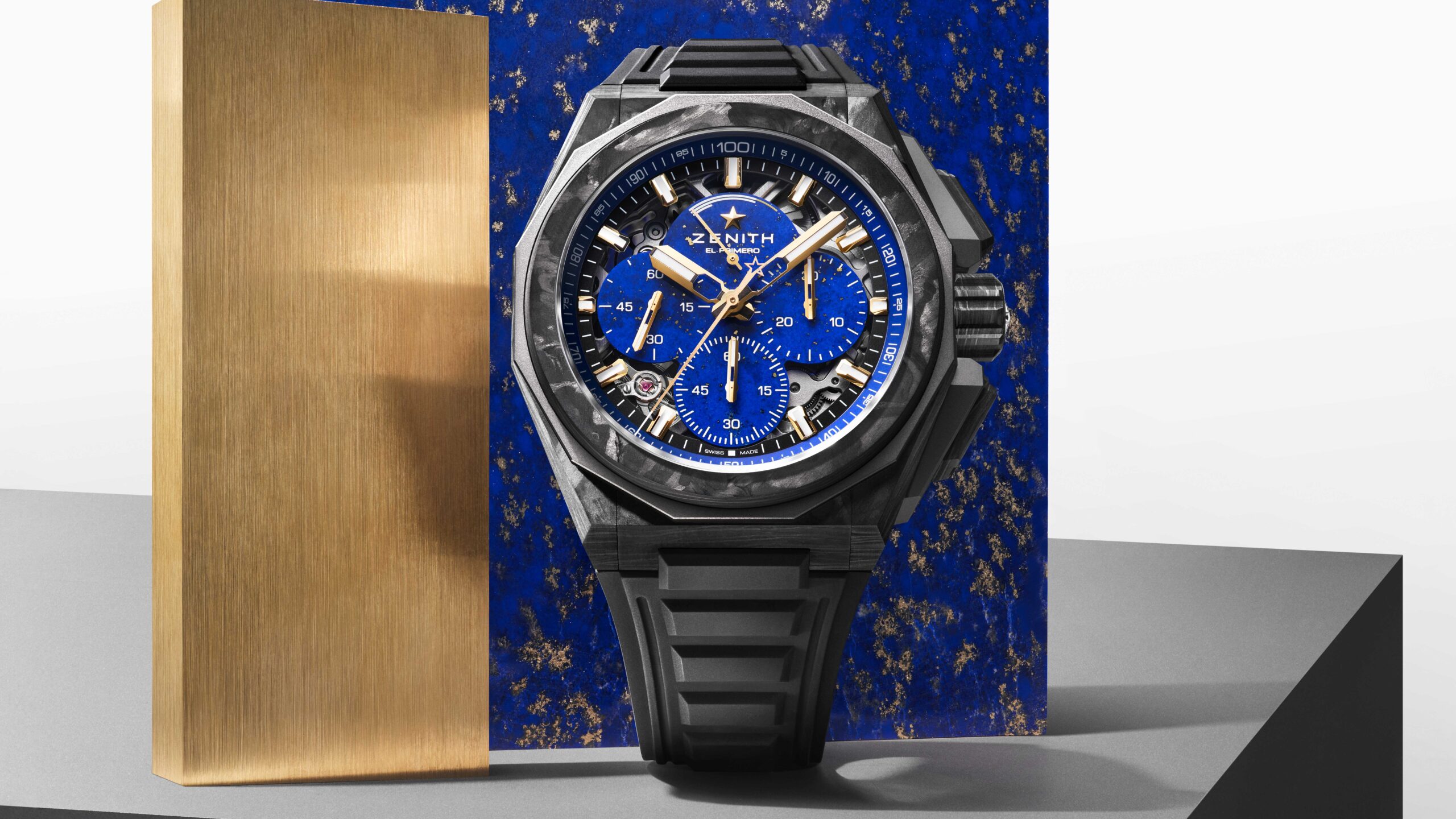

Zenith swaps steel and gold for forged carbon, giving its lapis lazuli DEFY Extreme a darker, more technical edge without losing its cosmic-blue centrepiece.
Zenith’s DEFY Extreme has always been the brand’s most uncompromising statement. It’s the company’s only mechanical chronograph in regular production that measures elapsed time to 1/100th of a second, built around an escapement architecture nothing else on the market attempts. The DEFY Extreme Lapis Lazuli II keeps that engineering intact but changes the conversation around it, swapping the steel and yellow gold of the original Lapis Lazuli edition for the deep matte texture of forged carbon.
A Sharper Take on an Established Idea
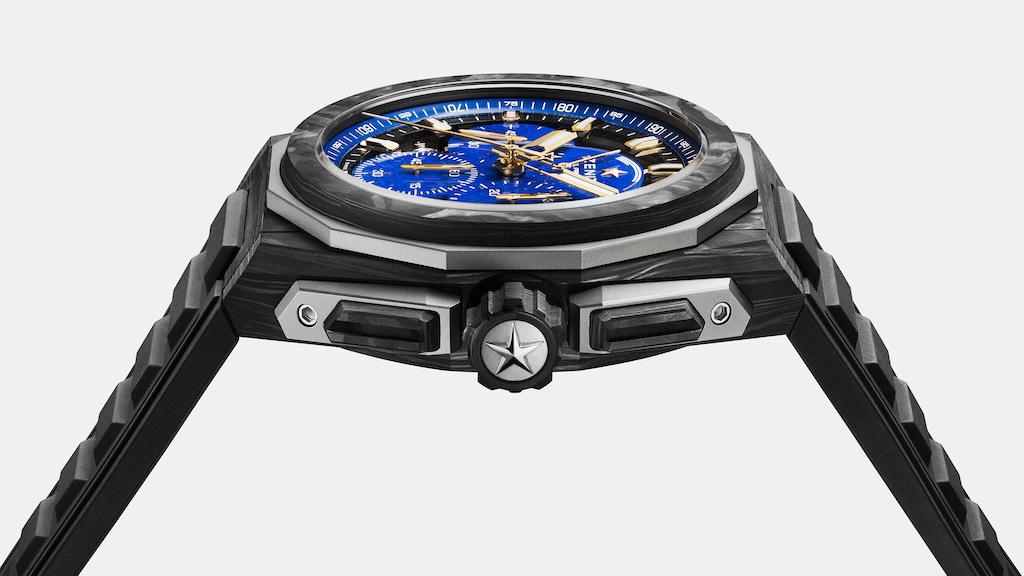
The first DEFY Extreme Lapis Lazuli paired natural stone with polished metal, letting the two play off each other in reflected light. This second edition, limited to just 50 pieces, takes a more technical route. Forged carbon replaces the metallic surfaces almost entirely, and the effect is immediate: instead of catching light, the case absorbs it, giving the watch a stealthier, more graphic presence on the wrist while sharpening the contrast with the dial’s vivid blue centre.
That contrast is really the point of the whole watch. Lapis lazuli is about as far from forged carbon as two materials get — one natural and ancient, the other engineered purely for performance. Putting them together shouldn’t work on paper. In practice, it’s what makes the piece.
Carbon and Titanium, Built for the Case
The 45mm case combines forged carbon with titanium, a pairing chosen for weight as much as looks. Titanium keeps the watch light on the wrist despite its size, while carbon adds structural resistance without adding bulk. The matte, textured surfaces reinforce the case’s bold geometry while pushing the whole watch closer to tool-watch territory than jewellery.
Lapis Lazuli, Doing What Only Stone Can Do
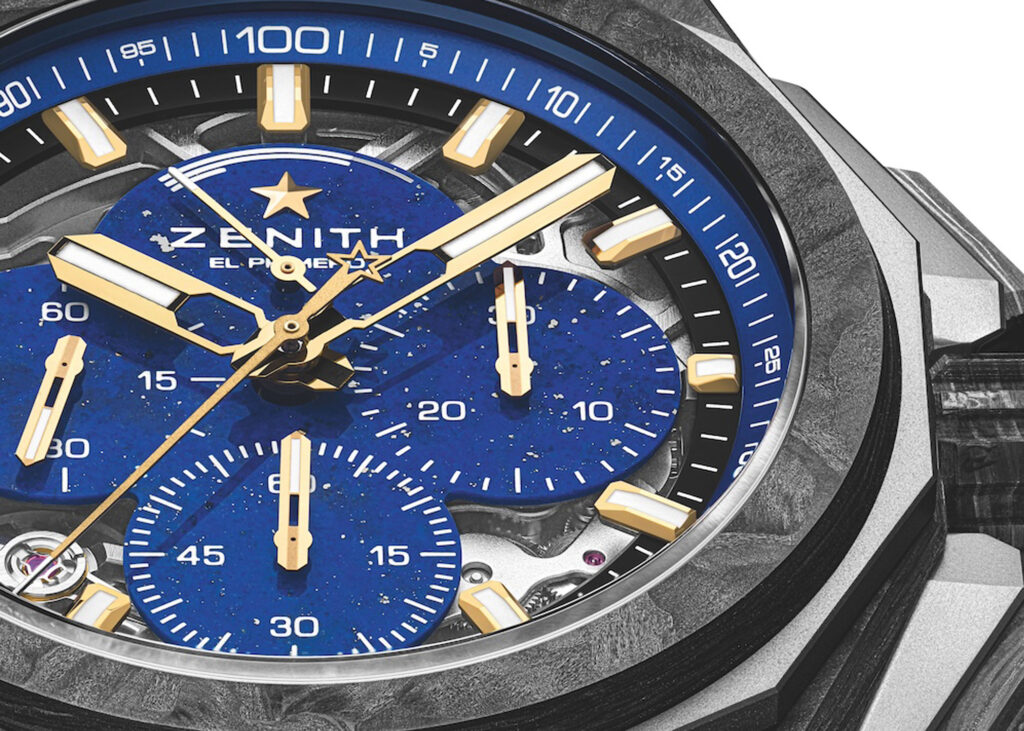
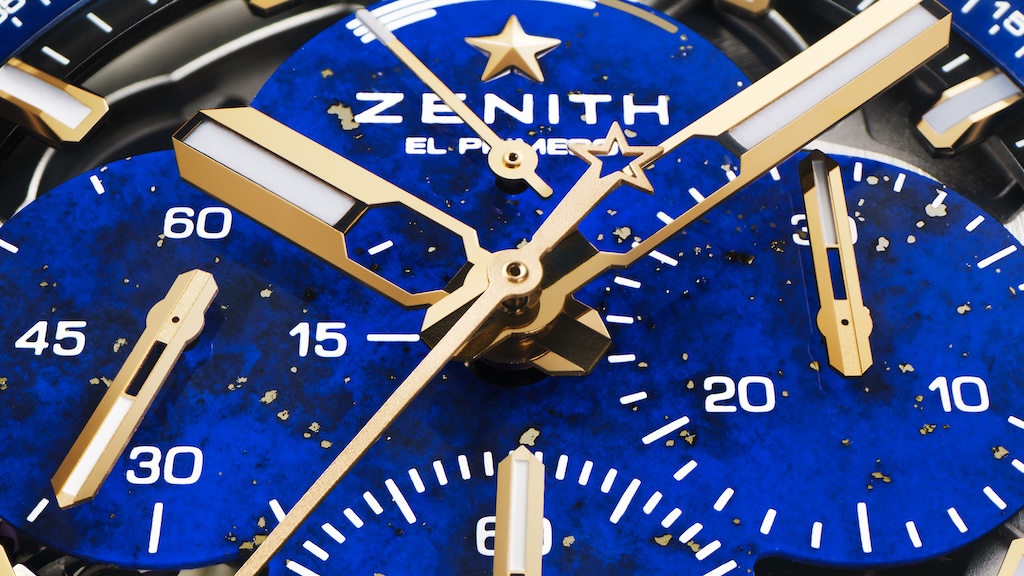
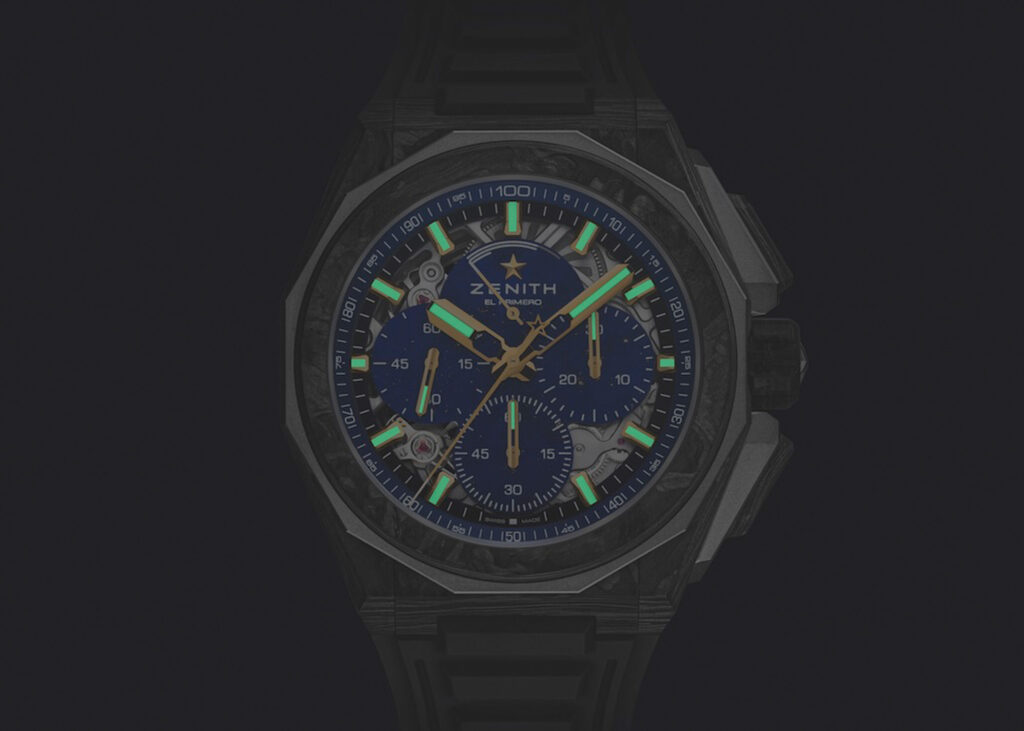
Set within the dial’s openworked construction, the lapis lazuli counters are where the unpredictability lives. Natural pyrite inclusions running through the stone catch light differently depending on the angle, throwing off small golden flashes against the otherwise dark, technical construction around them. This is a detail no synthetic material could replicate consistently, and part of why lapis lazuli remains a favourite among watchmakers chasing something with real character. Yellow gold-plated indexes and Super-LumiNova keep things legible without disrupting that balance.
The layout itself is dense but considered, combining central hours and minutes and a small seconds at 9 o’clock with a 30-minute chronograph counter at 3 o’clock, a 60-second counter at 6 o’clock, and a chronograph power reserve display at 12 o’clock. At the centre, a chronograph hand completes a full rotation every second, turning what’s normally an abstract 1/100th-of-a-second spec into something you can actually watch happen.
The El Primero 9004: Two Escapements, One Watch
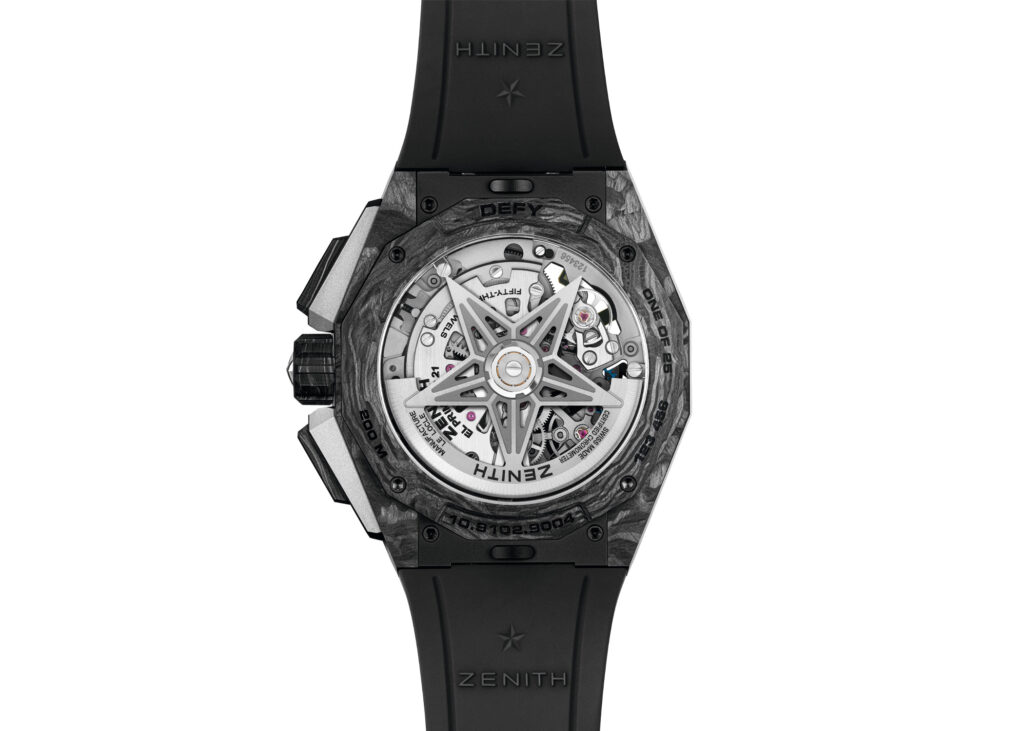
The engineering underneath is the real story. The El Primero 9004 runs two independent escapements, one at 5Hz (36,000 vibrations per hour) for standard timekeeping, the other at a startling 50Hz (360,000 vibrations per hour) dedicated solely to the chronograph function. That dual architecture is what makes the 1/100th-of-a-second measurement possible at all, and it does so while still delivering a 50-hour power reserve for everyday timekeeping and 50 minutes of chronograph runtime.
Through the sapphire case back, the star-shaped oscillating weight appears in a satin-brushed finish, a quiet nod to Zenith’s five-pointed-star signature.
Built to Be Worn, Not Just Displayed
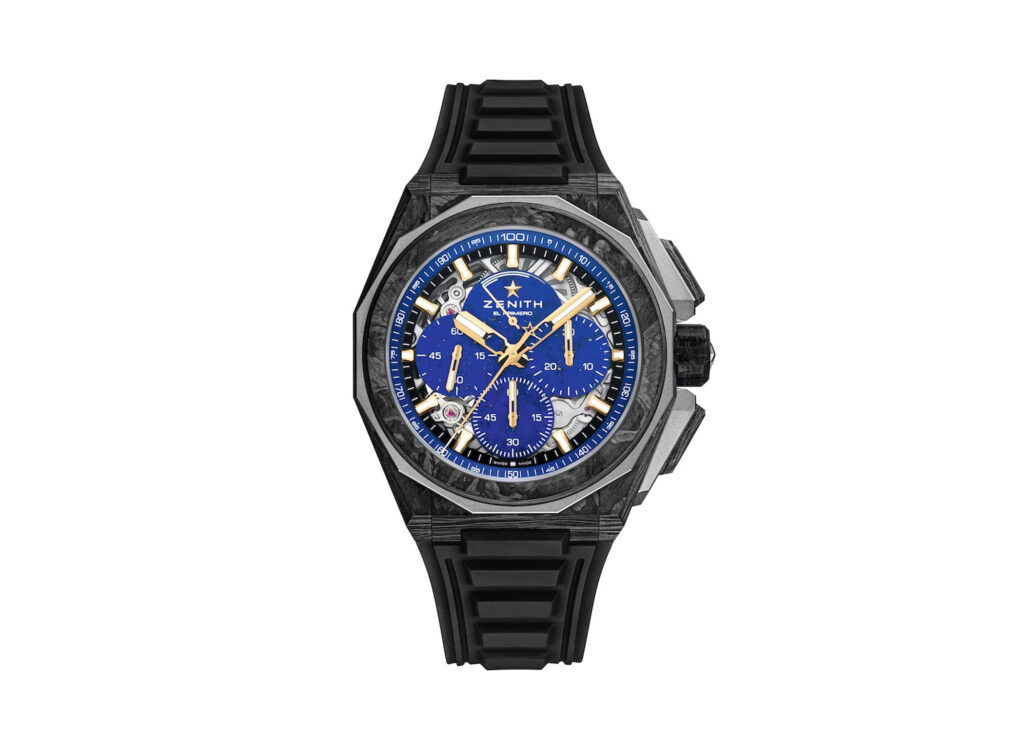
Even better, practicality hasn’t been sacrificed for the concept. The watch ships with a black rubber strap on a folding clasp and a black high-performance Velcro strap, both swappable through the DEFY Extreme’s interchangeable strap system built into the case back.
Why It’s Worth Watching
The Lapis Lazuli II isn’t a softer DEFY Extreme — if anything, it’s a more focused one. Stripping away the first edition’s metallic shine sharpens the contrast between engineered material and natural stone, while keeping the El Primero 9004’s rare precision at the centre. At 50 pieces, it’s a limited, deliberate statement and a clear signal of where Zenith wants this line to go next.