
The latest opening at Causeway Bay’s CUBUS complex redefines the art of Japanese barbecue — one perfectly grilled cut at a time.
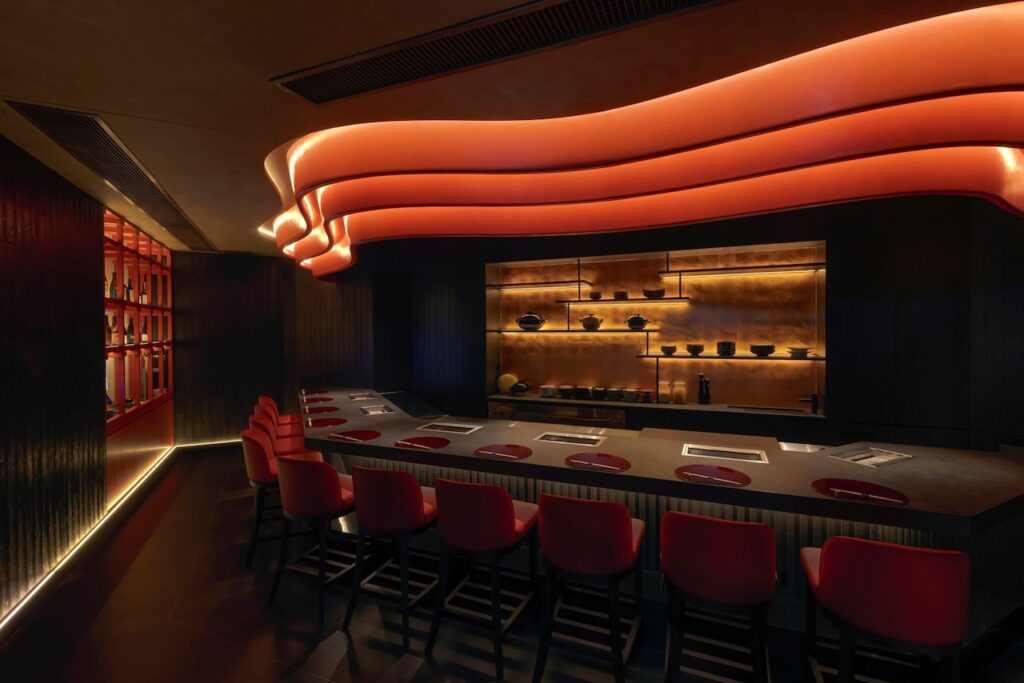
I love that there’s something almost clandestine about Yakiniku Yama Oku. Tucked away on the third floor of Causeway Bay’s CUBUS complex, the intimate eatery accommodates just 12 diners at a time, with those lucky souls gathered around a single counter like guests at a very exclusive dinner party.
The name, which translates roughly to “deep in the mountains,” nods to Japan’s Shogunate era, when villagers cooked meat over hidden hearths at a time when Buddhist prohibitions forbade livestock consumption. It is an apt metaphor. This is yakiniku as a secret society.
The interiors reinforce the mythology. Dark textured wood lines the walls and floor, wave-like ceiling panels cast a warm sunset-red glow, and crimson counter chairs flank a show kitchen where a tight team of chefs — led by Fukuoka-born duo Koji Takazono and Koichi Kuga — work with the focused precision of watchmakers. Despite a rather electic soundtrack piped in through hidden speakers, the focus is undeniably on the culinary craft.
Start As You Mean to Go On
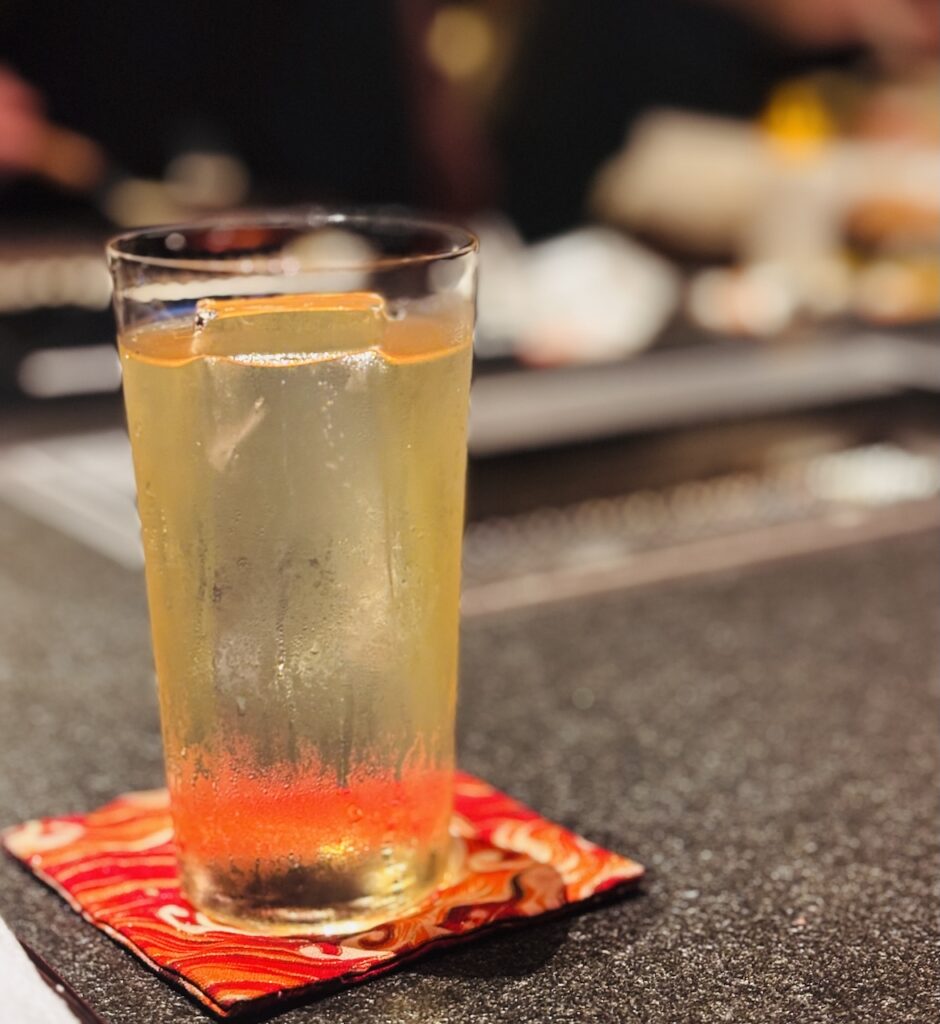
Proceedings begin with a highball, and not merely any highball. Yakiniku Yama Oku pours Kanosuke, an award-winning whisky from the boutique Kushu distillery in Kagoshima, paired with artisanal soda water and served over ice that could pass for a design object. The resulting highball is clean, lightly smoky and, crucially, does not compete with what follows. Wise.
The Omakase Unfolds
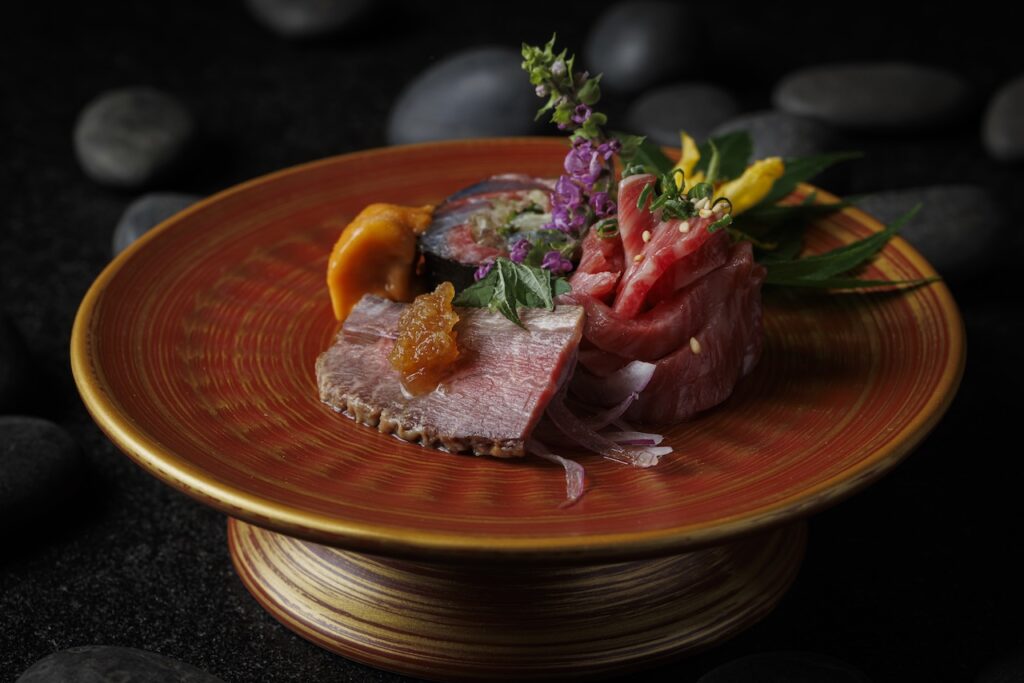
The Sui omakase menu (HK$1,180++) moves through its courses with the rhythm of a concerto — nothing superfluous, nothing wasted, just a clear focus on the ingredients at hand.
The opening sequence of meat appetisers sets an ambitious tone. Oita wagyu rump arrives tartare-style, partnered with a fermented egg yolk that adds a briny, almost funky depth. A delicate (and curious) sushi roll of wagyu and flounder, kombu-cured and finished with sea urchin and a breath of wasabi, is quietly sensational and the kind of bite that makes you put down your drink. Slow-cooked wagyu cheek with house-made onion jam closes this chapter; the meat has given up all resistance and the jam brings a gentle sweetness that lingers like a love letter to winter.
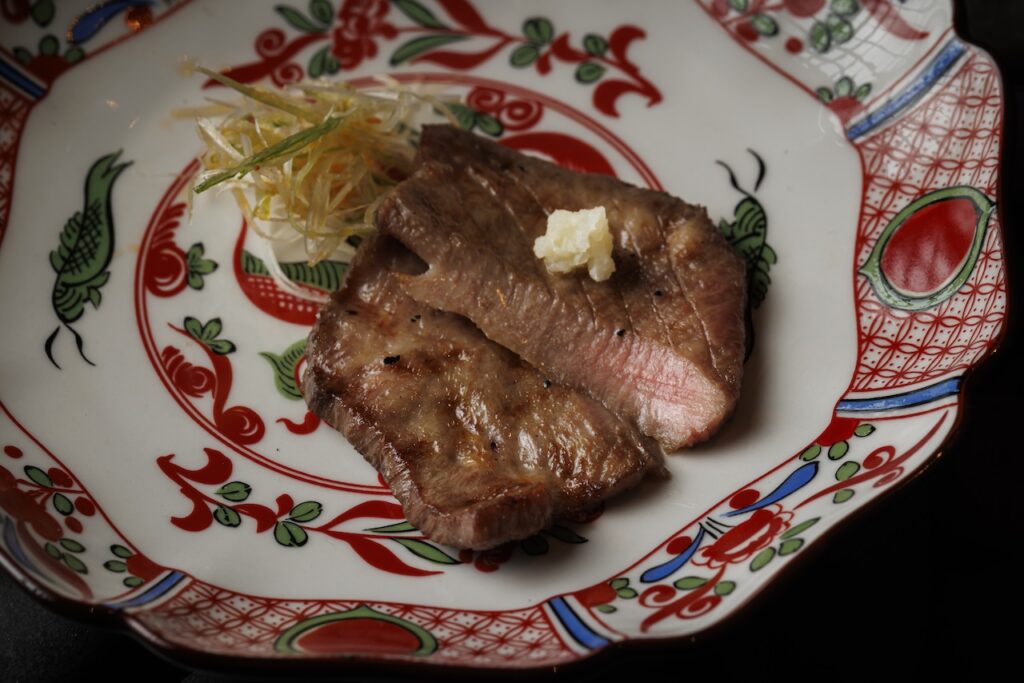
Then it’s on to beef tongue, which is shaved to translucent thinness and topped with a lemon salt (another homemade addition) that has been fermenting for a week. It sounds minimal on paper but tastes like summer on the palate.
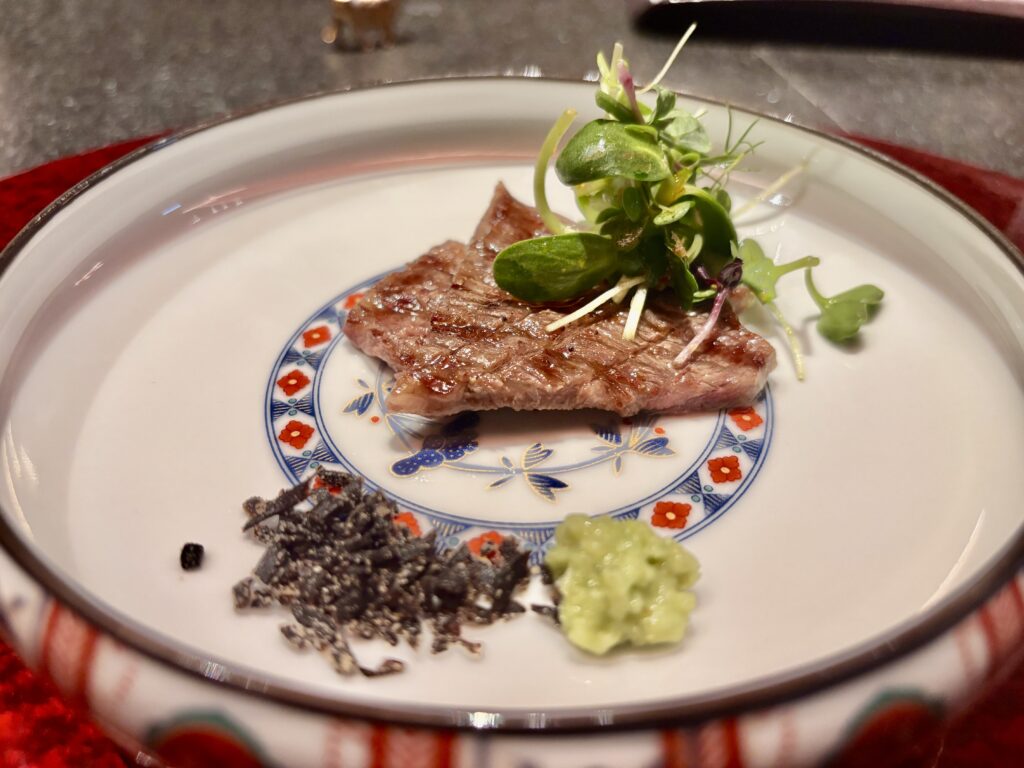
The rump core, grilled and served with warming wasabi and zesty seaweed salt, demonstrates what top-grade Wagyu from Oita Prefecture actually is when treated with respect rather than smothered in sauce. The whisper-light Korean-dressed salad that follows is more playful: the dressing remains pleasantly understated, and instead it’s the meat itself — impossibly tender — that carries the dish, the seaweed salt cutting through its richness with Ginsu 2000 precision.
The Signature Moments
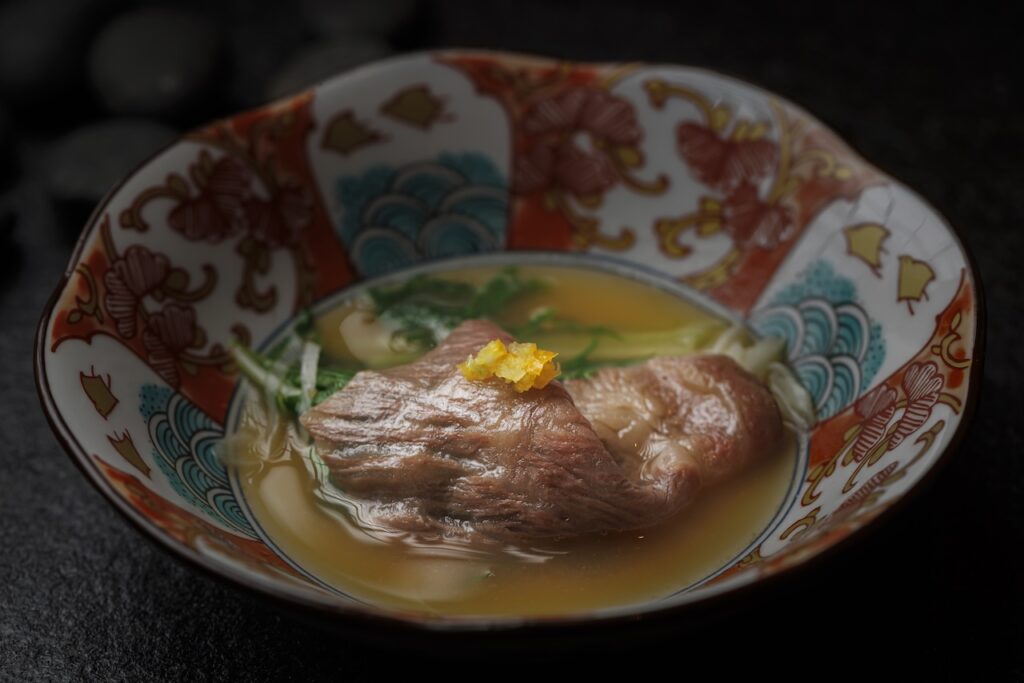
Midway through the evening, a bone broth arrives — shin and tail, simmered for 72 hours — with appropriate theatrics and into which a ribbon of dry-aged ribeye is submerged for the briefest of moments. The broth, if I’m honest, is subtler than the cooking time might suggest, but the ribeye itself is something else entirely: yielding and silken, it barely needs to be chewed. Served with Chinese leeks, it is the kind of dish that earns the word “umami” without resorting to it.
The seven-day dry-aged Chateaubriand, grilled over charcoal at stations along the counter and presented with pink salt, wasabi and more of that heady onion jam, comes with charcoal-grilled potato, asparagus and mushroom. It’s the kind of main event that requires a moment of respectful silence before eating. The exterior carries that subtle charcoal char while inside, the meat is rose-red and yielding.
After a palate cleanser of Sudachi citrus ice granite crowning cold Morioka noodles, a cold compress for the senses, the restaurant’s signature Yamaoku-Yaki, is prepared. A wafer of beef, briefly bathed in soy and sugar then cooked over flame, is dexterously wrapped around an aged egg yolk and a thimble of sushi rice. The result is sweet, savoury, rich and impossibly neat and I’ll admit I’d come back just for this dish.
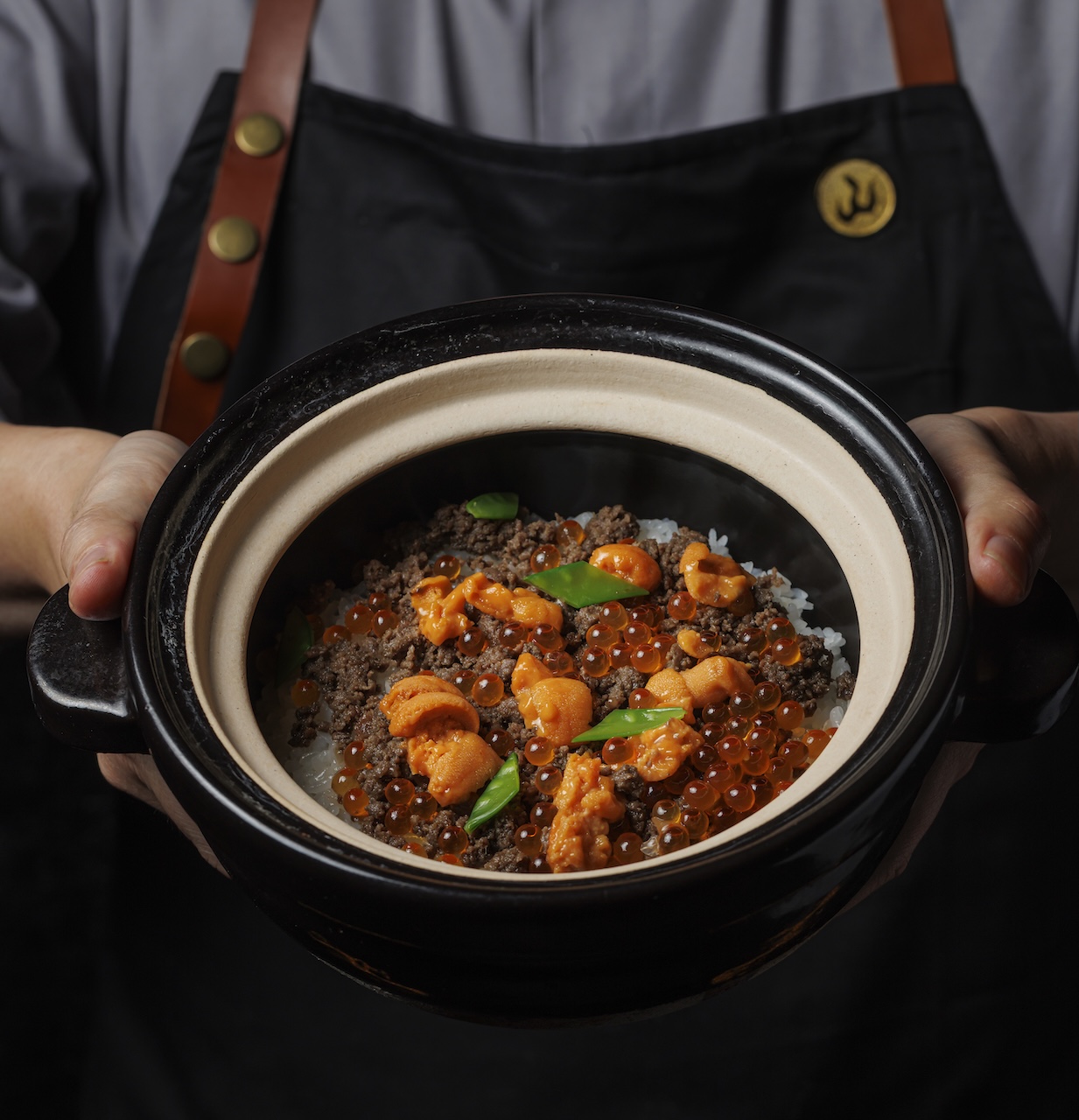
Shortly after, a tantilising strip of tenderloin, submerged this time in soy and ginger, offers its own quiet pleasure, followed by a bowl of finely chopped wagyu tartare, sea urchin and salmon roe mixed into freshly cooked Koshihikari rice and served from a traditional Nagatanien claypot. By this point, the cumulative effect of the evening begins to feel genuinely luxurious.
Dessert — a Japanese riff on panna cotta with yoghurt cream, stewed peach, grape jelly and caramel sugar — lands with elegance and restraint. It’s nothing if not a sweet full stop.
The Verdict
Yakiniku Yama Oku is among the most considered restaurant openings Hong Kong has seen this year. It’s intimate to the point of feeling personal (so choose your dining companion carefully), precise without being cold, lively thanks to its intimate confines, and yet quietly exceptional from that first (of many) highball to that final spoonful of peach bliss.
Book early. All twelve seats will not stay empty for long.